
Tools
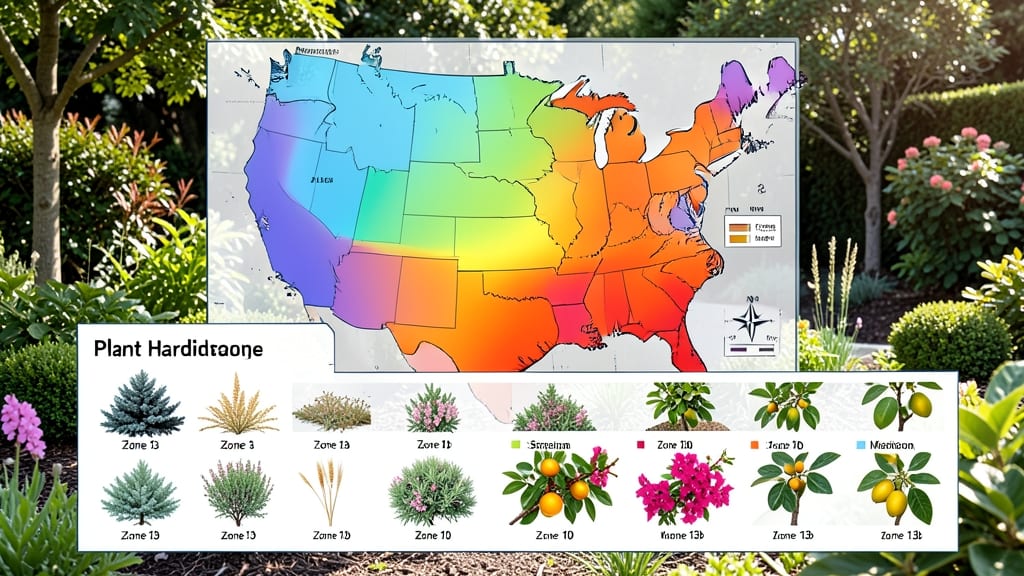
Understanding North America gardening zones—from 1 (coldest) to 13 (hottest)—helps you pick plants that survive your area's average winter lows. The USDA Plant Hardiness Zone Map shows which species thrive based on your region's climate patterns.
These zones are based on the coldest temperatures your area typically sees, not summer heat. 🌡️ For example, Zone 5 can handle down to -20°F, while Zone 9 barely dips below 20°F. Microclimates—like sunny slopes or shaded valleys—can shift your effective zone by one or two numbers, so always observe your garden's specific conditions.
The map also accounts for elevation changes, which can make higher-altitude areas colder than their latitude suggests.
Once you know your zone, you can select plants with matching hardiness ratings. Perennials and trees need permanent placement in their ideal zone, while annuals offer more flexibility for temporary planting. Transition zones (like 6b/7a) often require extra care, such as mulching or choosing varieties bred for borderline conditions.
💡 In This Article
- How USDA Plant Hardiness Zones Define Plant Survival
- Choosing Plants for Your Zone: A Region-Specific Guide
How USDA plant hardiness zones define plant survival
The USDA Plant Hardiness Zone Map isn't just about numbers—it's a precise scientific tool based on 30 years of temperature data collected from weather stations across North America. Each zone represents a 10°F difference in average annual minimum temperatures, with subdivisions (a/b) adding 5°F precision.
For example, Zone 5a (-20°F to -15°F) is significantly colder than Zone 5b (-15°F to -10°F), which explains why some plants thrive in one but not the other. 🌡️
What makes this system work is how it accounts for plant cellular responses to cold. When temperatures drop below 32°F (0°C), plant cells begin freezing, and ice crystals form in the intercellular spaces.
Most plants can handle some ice formation, but when temperatures reach -20°F (-29°C) or lower, the ice crystals rupture cell walls, killing the plant. The zone map helps you select species whose natural cold tolerance matches your area's typical lows.
Microclimates complicate things because they create localized temperature variations within the same zone. A south-facing wall can be 5-10°F warmer than the surrounding area, while a low-lying spot might experience 2-3°F colder temperatures. Elevation adds another layer—every 1,000 feet (305 meters) gain typically drops temperatures by 3.5°F.
That's why a garden at 5,000 feet in Colorado might behave like Zone 5, even if its latitude suggests Zone 7.
Here's what most gardeners overlook: Frost-free days matter just as much as winter lows.
The USDA map doesn't account for growing season length, which is why some Zone 8 areas (like parts of California) can grow tropical plants, while others (like the Midwest) can't. For instance, Zone 8 in Florida averages 250+ frost-free days, while Zone 8 in New Jersey has only 180 days.
This explains why some plants thrive in one Zone 8 but fail in another.
For practical application, think of zones as plant survival guarantees. If you live in Zone 6 and plant a Zone 5 perennial, it has a 90%+ chance of surviving winter.
But plant a Zone 7 perennial in the same spot, and you're rolling the dice—it might survive one winter but succumb the next. The map gives you the odds, but microclimates and growing conditions can shift those probabilities dramatically. 🌱
Advanced gardeners use zone data to create transition zone gardens, where they mix hardy and semi-hardy plants. For example, in Zone 6b/7a (border areas), you might plant Russian sage (Zone 4) for reliability and Oleander (Zone 8) in microclimates where winter lows rarely dip below 15°F (-9°C).
The key is observing your garden's specific conditions for at least 3 years to refine your zone-based plant selections.