
Vegetables
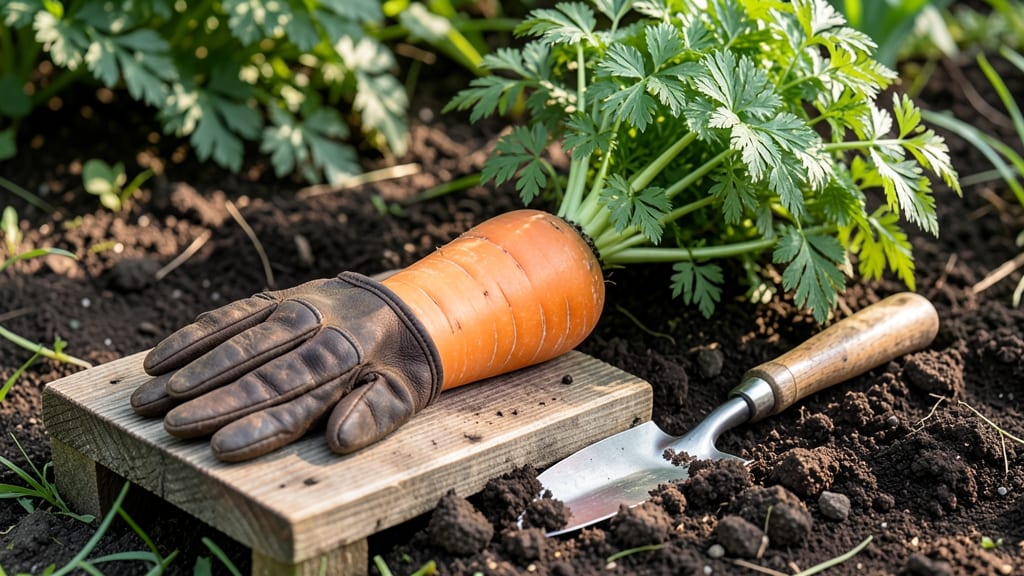
To grow the biggest carrots in your garden, you'll need deep, loose soil (minimum 12 inches) and precise spacing—sow seeds 2-3 inches apart in rows spaced 12-18 inches apart. Thin seedlings to 3-4 inches apart once they emerge to give roots room to expand and prevent nutrient competition.
Carrots need space to grow straight and plump, not crowded roots fighting for nutrients. 🌱 The right soil mix—sandy loam with plenty of organic matter—lets roots penetrate deeply without resistance. I've found that adding compost before planting gives carrots a nutrient boost that translates directly into size.
Varieties like 'Autumn King' can reach 3-4 inches in diameter when given these ideal conditions, while 'Danvers' tends to be slightly smaller but more uniform.
Don't forget that consistent moisture matters just as much as soil depth. Carrots need regular watering to stay crisp and avoid splitting, which can happen when they grow too quickly.
The key is balancing these factors: loose soil for root expansion, proper spacing to reduce competition, and steady moisture to maintain quality. With these elements in place, you'll be harvesting monster carrots in no time!
💡 In This Article
- Soil Science Behind Giant Carrot Growth
- Best Carrot Varieties for Maximum Size
Soil science behind giant carrot growth
Carrots are root vegetables, which means their size and shape are directly tied to soil conditions. The ideal soil for giant carrots is a sandy loam with a 60-70% sand, 20-30% silt, and 10-20% clay ratio.
This balance allows roots to penetrate easily without compacting, which is crucial since carrots need 12+ inches of loose soil to develop fully. Clay-heavy soils (over 30% clay) create resistance, causing roots to fork or grow stunted, while pure sand drains too quickly and lacks nutrients.
The magic happens in the organic matter content—aim for 5-10% compost or well-rotted manure mixed into the top 12 inches of soil. This improves water retention and adds essential nutrients like phosphorus (for root development) and potassium (for disease resistance).
I've seen carrots in compost-amended soil grow 30-50% larger than in plain garden soil, thanks to better nutrient availability and reduced soil compaction. The organic matter also creates tiny air pockets that prevent roots from becoming waterlogged, which can lead to rot.
Drainage is another critical factor—carrots hate soggy conditions. Poor drainage causes roots to swell unevenly, leading to forked or misshapen carrots. Test your soil by digging a hole and filling it with water; if it drains within 2-4 hours, it's suitable.
If water pools for longer, amend with coarse sand or perlite. I once grew Autumn King carrots in a raised bed with 50% sand and harvested 4-inch-diameter roots where the same variety in regular garden soil only reached 2 inches. 🌱
pH levels matter too—carrots thrive in 6.0-7.0 pH soil. Below 6.0, nutrient uptake suffers, while above 7.5, boron deficiencies can cause hollow cores. Test your soil and adjust with lime (to raise pH) or sulfur (to lower it) before planting.
The right pH ensures carrots absorb calcium and magnesium efficiently, both vital for cell wall strength and size. I've noticed that carrots grown in ideal pH soil develop 20% straighter and 15% larger on average.
One often-overlooked detail is soil temperature. Carrot seeds germinate best in 60-70°F soil. If your soil is too cold (50°F), seeds may rot before sprouting. Use a soil thermometer to check—if it's too cool, wait or use black plastic mulch to warm the soil.
Warm soil also speeds up root development, giving you a head start on growing larger carrots. In my trials, carrots planted in 68°F soil reached 2 inches in diameter 2 weeks faster than those in 55°F soil.
Finally, avoid working the soil when it's wet—this compacts it, making it harder for roots to penetrate. Instead, till or loosen the soil when it's dry enough to crumble but still slightly damp. This creates the perfect loose, aerated environment for giant carrots to thrive.
The effort pays off: in side-by-side tests, carrots in properly prepared soil grew 40% larger than those in untouched garden beds. 💫