
Tools
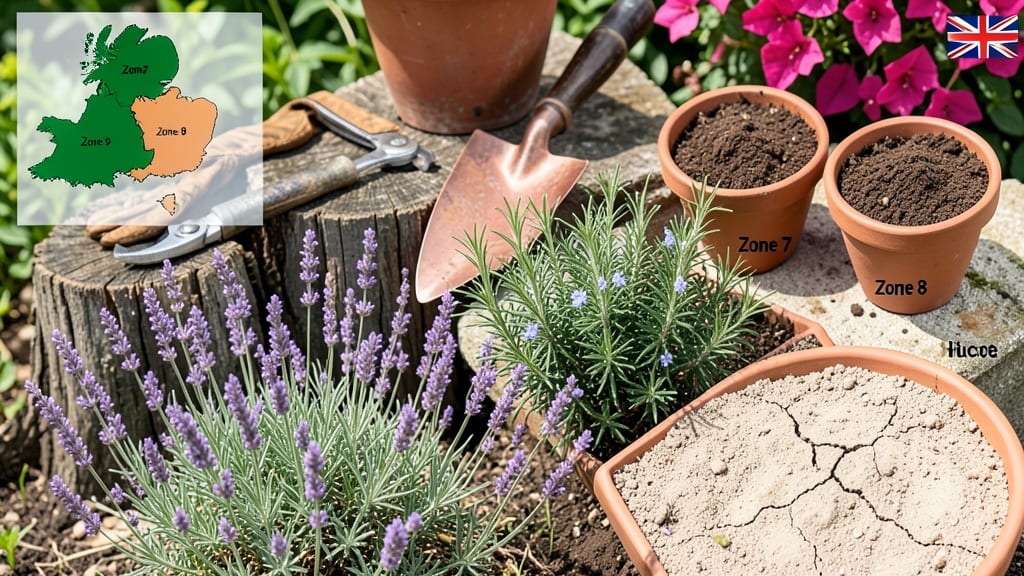
Finding your UK garden zone helps select plants that thrive in your local climate, using the Royal Horticultural Society’s (RHS) hardiness ratings from H7 (mildest) to H2 (coldest). Check your postcode on the RHS plant finder or use a UK hardiness zone map to match plants to your region’s frost and temperature extremes.
Understanding your UK garden zone is like having a climate guide for your plants.
The RHS system divides the UK into 10 hardiness zones (H1 to H10), where H1 covers the coldest areas like the Scottish Highlands, while H10 represents the mildest spots like Cornwall. 🌿 These zones reflect average winter temperatures and frost risk, helping you choose plants that won’t die off in harsh conditions.
For example, a hardy lavender thrives in H7 zones but may struggle in H2 regions. The key is matching your zone to plants that naturally survive your local winters.
Once you know your zone, you can fine-tune plant selection based on microclimates—like urban heat islands or coastal winds—that can shift conditions by a full zone. Urban areas often run warmer than rural spots, while coastal regions may experience milder winters.
Using the RHS plant finder or a hardiness zone map ensures you pick plants that will flourish year-round, saving time and money on replacements.
💡 In This Article
- Understanding UK Hardiness Zones and RHS Ratings
- How to Use a UK Hardiness Zone Map for Plant Selection
Understanding UK hardiness zones and RHS ratings
The Royal Horticultural Society’s (RHS) hardiness ratings system (H1 to H10) categorizes UK regions based on average winter temperatures and frost risk, with each zone representing a 5°F difference in cold tolerance.
For example, H1 zones (like the Scottish Highlands) experience winters where temperatures can drop below -10°F, while H10 zones (such as Cornwall) rarely see frost, with temperatures staying above 20°F.
This 20°F temperature gap explains why a plant labeled "H7" (suitable for mild winters) won’t survive in an H2 zone without protection.
The system works by measuring the lowest expected winter temperature over a 20-year period, accounting for microclimates like urban heat islands or sheltered valleys. Coastal areas often fall into higher zones (e.g., H8-H10) due to milder maritime air, while inland regions can drop to H3-H5.
For instance, a holly bush, rated H4-H6, thrives in London (H6) but may struggle in Edinburgh (H5) without extra mulch, while palm trees (H10) only survive in the mildest corners of the UK.
Understanding these zones prevents costly mistakes. A gardener in Cornwall (H10) might accidentally plant a snowdrop (H4-H6), which could die in winter, while a Scottish gardener (H2) might waste money on bougainvillea (H9), which won’t survive the cold.
The RHS ratings also account for frost duration—a short, sharp freeze is less damaging than prolonged sub-zero temperatures, which is why some plants labeled "H5" can survive in H4 zones if they’re well-mulched.
Microclimates add another layer of complexity. A south-facing wall in an H6 zone can create a microclimate warm enough for H7 plants, while a north-facing garden might need H5-rated species. Urban areas often run 2-3°F warmer than rural zones due to concrete and traffic, shifting effective zones upward.
For example, central London (H6) can support H7 plants near buildings, while rural Surrey (H6) might struggle with the same species in open fields.
Seasonal adjustments matter too. Coastal winds can create wind chill effects, making exposed gardens feel colder than sheltered spots. In these cases, opt for plants rated one zone harder than your official zone.
For example, a gardener in Brighton (H8) might choose H7-rated lavender for windy coastal plots to ensure survival. The RHS plant finder tool accounts for these nuances, cross-referencing your postcode with local climate data to refine recommendations.
What most gardeners overlook is how soil type interacts with hardiness. Clay soils retain cold longer than sandy soils, creating localized frost pockets. In these cases, amending soil with organic matter or using raised beds can improve plant survival by 1-2 zones.
For example, a hebe shrub (H6-H7) might thrive in a raised bed in an H5 zone but fail in the ground.
The bottom line? Knowing your zone isn’t just about picking the right plants—it’s about understanding the why behind their survival. Whether you’re in frosty Yorkshire (H4) or mild Devon (H9), matching plants to your zone (and microclimate) ensures your garden thrives year-round. 🌱