
Tools
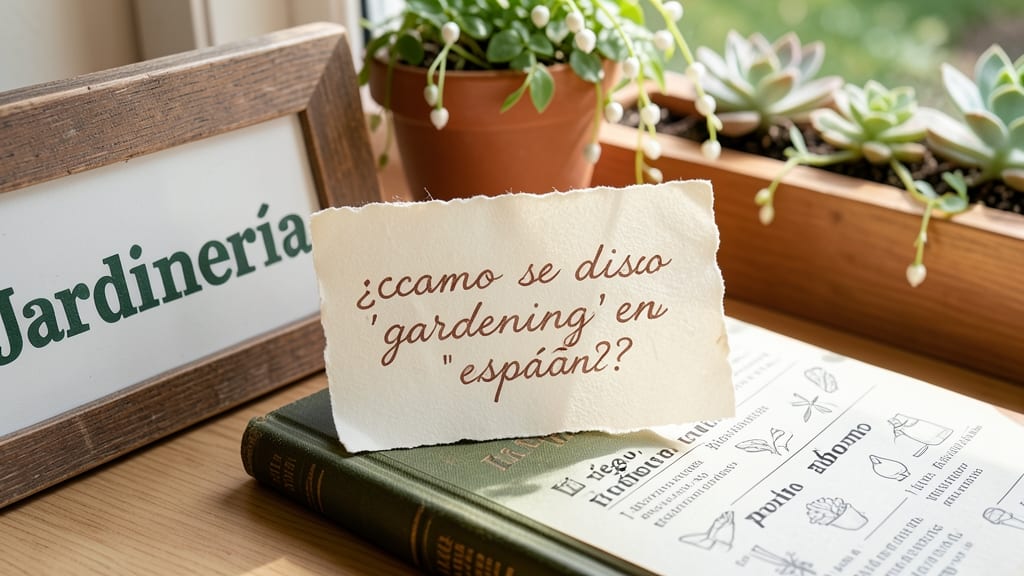
To say 'gardening' in Spanish, use jardineria (pronounced har-dee-nee-ah), the standard term for the practice. For regional variations, huerto refers to vegetable gardening, while jardinería (same spelling) covers broader horticulture. Always check context—pronunciation varies by dialect, especially in Latin America vs. Spain.
Spanish gardening terminology reflects both the language's regional diversity and cultural gardening traditions. The word jardineria comes from jardín (garden), showing its focus on ornamental and decorative plant care. 🌿 Meanwhile, huerto emphasizes practical, edible plant cultivation—think backyard vegetable patches or community gardens.
In Mexico, you might hear huerta for home gardens, while in Argentina, huertico refers to small-scale urban gardening projects. Even the pronunciation shifts: in Spain, the j sounds like a soft h, but in Latin America, it often takes on a ch or h sound depending on the country.
What's fascinating is how these terms connect to local gardening practices. For example, milpa—a traditional Mesoamerican farming system combining corn, beans, and squash—has no direct translation in Spain but is deeply tied to huerto culture in Central America.
Meanwhile, quinta, common in Andean regions, refers to both gardens and small rural estates, blending horticulture with agricultural life. Understanding these nuances helps you communicate more effectively with Spanish-speaking gardeners worldwide.
💡 In This Article
- Spanish Gardening Vocabulary Breakdown
- Regional Spanish Gardening Terms by Country
Spanish gardening vocabulary breakdown
The word jardineria traces its roots to the Old French jardin, which entered Spanish through medieval trade and cultural exchange.
The term specifically refers to the art and practice of cultivating plants—whether ornamental, medicinal, or decorative. 🌿 Unlike English, which uses a single word for all gardening activities, Spanish distinguishes between jardineria (broad horticulture) and huerto (focused on edible crops).
This distinction reflects the language's practical approach to plant cultivation, where huerto carries connotations of sustenance and productivity, often associated with family plots or community gardens.
Pronunciation varies dramatically across dialects.
In Spain, jardineria is pronounced with a soft h sound for the j—almost like "har-dee-nee-ah"—while in many Latin American countries, the j sounds closer to a ch or h (e.g., "har-dee-nye-ah" in Mexico). 🌎 Even within Latin America, regional accents play a role: in Argentina, the r in jardin might roll strongly, while in Colombia, the i sounds more like "ee."
For gardeners traveling or communicating across borders, these nuances can transform a simple conversation—imagine ordering semillas (seeds) in a Spanish market but mispronouncing jardineria and accidentally asking for a "hardening" tool instead of gardening supplies!
Beyond the core terms, Spanish offers a rich vocabulary for gardening tools and techniques. Maceta (pot), pala (shovel), and regadera (watering can) are universally understood, but regional terms add flavor: azada (hoe) in Spain becomes pala de mano in some Latin American dialects.
The word podar (to prune) is consistent, but abono (fertilizer) might be called compost in urban settings or humus in agricultural contexts.
These variations highlight how gardening terminology adapts to local climates and traditions—like how riego por goteo (drip irrigation) is more common in arid regions of Spain than in lush, rain-fed gardens of Costa Rica.
What’s often overlooked is how Spanish gardening terms reflect cultural priorities.
For instance, jardineria terapéutica (therapeutic gardening) is a growing field in Spain, blending horticulture with mental health, while agricultura urbana (urban farming) dominates Latin American cities like Medellín or Bogotá. 🌱 These specialized terms show how the language evolves with modern practices, proving that jardineria isn’t just about plants—it’s about community, sustainability, and even healing.
Whether you’re discussing flores (flowers) or hortalizas (vegetables), the words carry layers of meaning tied to history and lifestyle.
For practical use, start with jardineria for general gardening and huerto for edible plants. Pair these with maceta (pot), tierra (soil), and riego (watering) to cover basics. If you’re in Mexico, huerta might be more familiar for home gardens, while in Spain, jardín alone could suffice in casual conversation.
The key is observing how locals use these terms—listening to a Mexican jardinero (gardener) discuss milpa or a Spanish agricultor talk about olivos (olive trees) will give you deeper insight than a dictionary ever could.
Pro tip: Use ¿Cómo se dice "gardening" en español? (How do you say "gardening" in Spanish?) as a conversation starter with native speakers. They’ll often correct your pronunciation and introduce you to local gardening slang—like guacal (a wooden planting tray in Central America) or toma (a watering channel in Andalusia).
The language of gardening is as diverse as the soil it describes!