
Tools
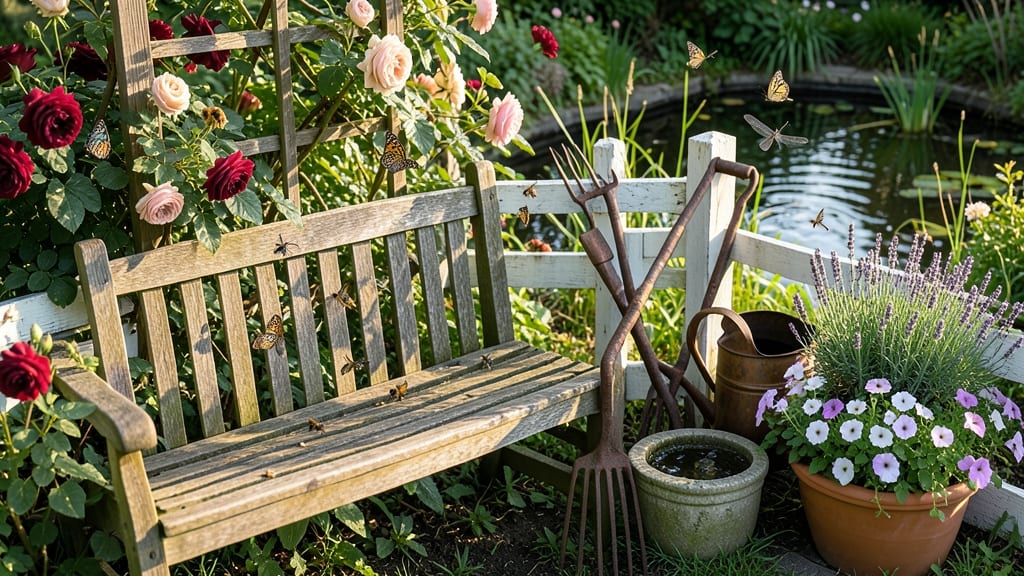
An English garden creates a romantic, informal outdoor space that prioritizes natural beauty over rigid structure, combining flowing pathways, climbing roses, and abundant perennials to craft a picturesque countryside retreat.
This style thrives on unstructured charm, where winding paths and soft borders replace straight lines, and layered plantings create depth through seasonal color shifts. 🌿 Unlike formal French gardens, English gardens embrace "messy" beauty—think overgrown roses, wildflower meadows, and hidden benches tucked under mature trees.
The magic happens in how these elements interact: fragrant herbs near seating areas, climbers framing doorways, and evergreens providing winter structure. Even the materials—weathered stone, rustic wood, and vintage pots—contribute to the nostalgic atmosphere.
What makes this design timeless is its adaptability. A small urban courtyard can mimic the feeling with container roses and trailing ivy, while a large estate might incorporate a wildflower meadow and ornamental pond.
The key is balancing structure with spontaneity, ensuring every season offers something new—spring bulbs, summer roses, autumn berries, and winter evergreens. 🌸
💡 In This Article
- Core Design Principles of Traditional English Gardens
- Iconic Plant Pairings for an Authentic English Look
Core design principles of traditional English gardens
At its heart, an English garden rejects rigid geometry in favor of organic flow, where nature's irregularities become design features.
The principle of layered planting creates depth by combining tall perennials like delphiniums (4-6 feet) behind medium shrubs such as hydrangeas (3-5 feet), with low ground covers like ajuga or thyme at the front.
This vertical stratification mimics natural ecosystems, where each plant has its own ecological niche. 🌿 The result is a visual journey that guides the eye through the space, rather than presenting a flat, two-dimensional display.
Pathways play a crucial role in this design philosophy. Unlike the straight, symmetrical paths of French gardens, English paths are winding and irregular, often made from gravel, stepping stones, or grassy meanders that invite exploration.
These routes should feel like discoveries—leading to unexpected views of a hidden bench, a burst of color from a rose arbor, or the shimmer of water from a small pond.
Water features, whether a formal fountain or a naturalistic pond, add another dimension by creating soundscapes that mask urban noise and attract wildlife like dragonflies and frogs.
The concept of soft edges is fundamental—borders between lawn and planting beds dissolve into natural transitions, with plants spilling gently onto pathways. This technique, known as naturalizing, creates a seamless transition between cultivated areas and wild spaces.
Even hedges are kept slightly unkempt, with hedgehog hedges (short, rounded shapes) or pleached trees (where branches are trained horizontally) adding texture rather than strict formality. The goal is to create a space that feels like it's been evolving for centuries, not meticulously arranged.
Seasonal interest is another cornerstone. English gardens are designed to offer visual appeal year-round through careful plant selection. Spring brings bulbs like daffodils and tulips, summer showcases roses and lavender, autumn displays berries and fiery foliage, and winter relies on evergreens like holly and boxwood.
The color wheel principle is often applied—pairing cool blues and purples with warm oranges and reds to create vibrant contrasts. For example, a blue delphinium (4-5 feet tall) planted beside a red geranium (2 feet tall) will draw the eye upward while maintaining balance.
Materials further enhance the romantic aesthetic. Weathered Yorkstone (a golden sandstone) or Cotswold limestone for pathways, cast iron for vintage-style benches, and terracotta pots add rustic charm. Even the arbor or pergola isn't just functional—it's often draped with climbing roses or clematis to create a living canopy.
The texture contrast between rough stone, smooth wood, and velvety petals adds tactile interest that invites touch and exploration. 🌸
Perhaps most importantly, English gardens prioritize atmosphere over perfection. The famous \"English disorder\" isn't actually disorder—it's a carefully curated sense of aged beauty.
This is why you'll often see deadheading (removing spent blooms) done selectively to maintain some natural decay, or wildflower meadows allowed to grow tall in one corner. The philosophy is that a garden should feel like a living, breathing entity rather than a static decoration.
This approach makes English gardens uniquely adaptable—whether you have a tiny balcony or a multi-acre estate, the principles can be scaled to create that signature romantic feel.