
Pests and Diseases
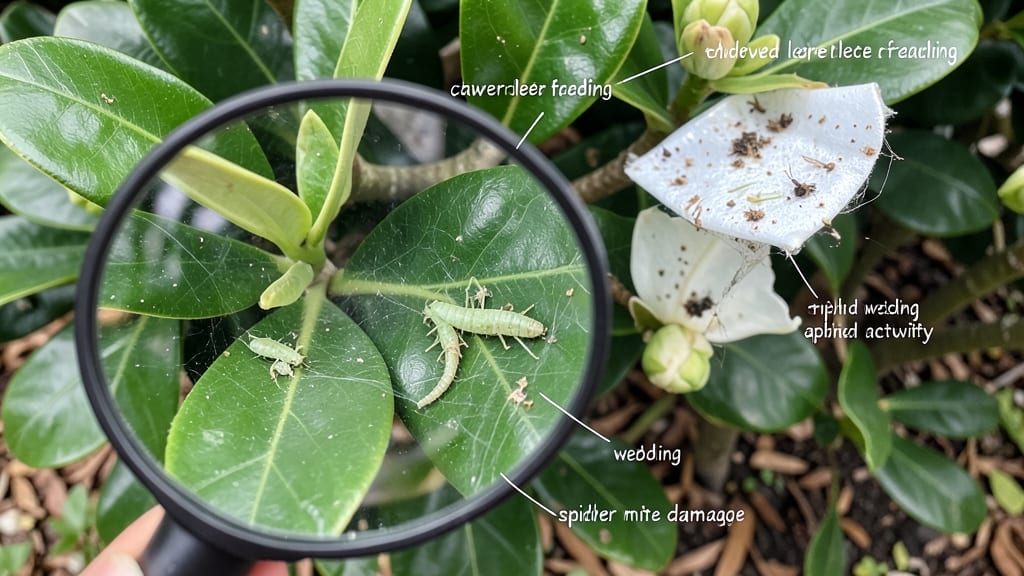
If your gardenia leaves are being eaten, the culprits are likely caterpillars, spider mites, aphids, slugs, or scale insects—each leaving telltale signs like jagged edges, fine webbing, sticky sap, or tiny white bumps. Examining the damage closely helps pinpoint the exact pest.
Gardenias are particularly vulnerable to these pests because their tender leaves provide easy access to nutrients. 🌿 Caterpillars typically create ragged holes along leaf edges, while spider mites leave behind a fine webbing on the undersides.
Aphids, on the other hand, excrete a sticky residue called honeydew, which can attract ants. Slugs leave behind slime trails and irregular bite marks, often targeting younger leaves. Scale insects appear as small, immobile bumps on stems or leaves.
To confirm your suspicions, inspect the undersides of leaves and stems carefully—most pests hide there. Early detection is key, as these pests can quickly spread and weaken your gardenia's overall health.
If you notice multiple types of damage, you may be dealing with more than one pest at once, requiring a combination of treatments.
💡 In This Article
- How to Identify Gardenia Leaf Damage by Pests
- Natural and Chemical Solutions for Gardenia Leaf Pests
How to identify gardenia leaf damage by pests
Caterpillars are among the most obvious culprits, leaving behind ragged, irregular holes along gardenia leaves.
These voracious feeders often target the softer new growth, creating jagged edges that resemble a 'windowpane' effect. 🌿 The key difference here is that caterpillar damage is usually accompanied by frass (tiny black fecal pellets) scattered across the leaves—this is your first clue.
Unlike other pests, caterpillars are mobile and often hide along stems or under leaves during the day, emerging to feed at night.
Spider mites, on the other hand, create a completely different visual signature. These microscopic pests leave behind tiny yellow or white speckles on leaves, often concentrated on the undersides.
The real giveaway is the fine webbing they spin between leaves and stems, which looks like delicate lace when viewed closely. 🕷️ Unlike caterpillars, spider mites thrive in dry conditions and their damage appears as stippling (tiny dots) before progressing to larger brown patches.
A magnifying glass helps spot their tiny red or yellow bodies moving along leaf veins.
When you notice sticky residue on leaves or nearby surfaces, aphids are likely the culprits.
These small, pear-shaped insects cluster on new growth and excrete honeydew—a sugary substance that attracts ants and promotes sooty mold growth. 🐜 The damage itself appears as curled or yellowing leaves, but the real clue is the shiny, sticky film that builds up over time.
Aphids are often found in large colonies, and a firm tap on the plant can make them fall like tiny raindrops onto the ground below.
Slugs leave behind a completely different set of clues. Their damage appears as irregular, slime-covered holes in leaves, often along the edges where they feed.
The key identifier is the silvery slime trail they leave behind—about 1/16-inch wide—which glistens in sunlight. 🐌 Unlike caterpillars, slug damage is usually more random and doesn't follow leaf veins.
You'll often find them hiding under mulch or large leaves during the day, emerging at night when humidity is high.
Scale insects are perhaps the most deceptive gardenia pests. They appear as small, immobile bumps—either white, brown, or black—attached to stems, leaf undersides, or even flower buds. 🐛 These pests suck plant sap, causing leaves to yellow and curl.
The damage often starts with just a few bumps but can quickly spread into dense colonies. Unlike other pests, scale insects don't move, making them easier to spot once you know what to look for. Their waxy coating makes them resistant to many sprays, requiring targeted treatments.
Here's a quick reference for visual identification:
- Caterpillars: Ragged holes + frass (black pellets) + mobile at night
- Spider mites: Yellow stippling + fine webbing + thrives in dry conditions
- Aphids: Sticky honeydew + curled leaves + attracts ants
- Slugs: Irregular holes + silvery slime trails + active at night
- Scale insects: Immobile bumps + sap-sucking damage + waxy coating